
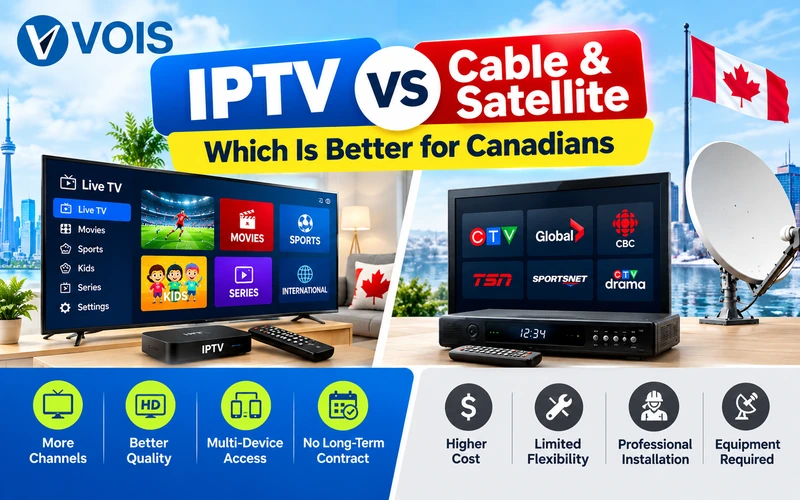
Cable prices continue to rise, two-year contracts continue to keep us trapped and that big set top box in the living room remains about the same as it was back in 2010. No wonder Canadians are searching for other options. IPTV Canada has risen up as a competitor, offering an alternative to cable and satellite TV services at a similar cost and number of channels. See below for a detailed comparison of the three so that you can see what’s best for your family.
Get access to thousands of live channels, movies, sports, and entertainment in HD and 4K. Choose a Vois IPTV subscription plan and start enjoying premium entertainment today.
VIEW IPTV SUBSCRIPTION PLANSBefore comparing pricing and performance, it helps to understand how each technology actually works.
Cable runs through coaxial wiring installed by regional providers — think Rogers, Bell or Shaw, depending on where you live. It’s been the default option in Canada for decades. The connection is usually stable, but flexibility is another story: in a lot of neighbourhoods, one provider effectively owns the market, so you take what’s offered.
Satellite works by beaming signals from orbit down to a dish mounted on your home. It’s often the only real option in places cable never reached — much of Northern Ontario, rural Quebec and similar areas. The trade-off shows up in bad weather: heavy snow or a serious storm can knock the signal out right when you want to watch something.
IPTV stands for Internet Protocol Television. In IPTV Canada, instead of cable or satellite, you receive channels or on demand services via your internet. This way you can watch your television, films or international channels on your smart TV or phone.
| Feature | Cable TV | Satellite TV | IPTV Canada |
| Installation | Technician required | Dish installation needed | Simple app setup |
| Contract Flexibility | Long-term contracts common | Long-term contracts common | Monthly, flexible plans |
| Weather Dependency | Minimal | High | None |
| Channel Variety | Regional bundles | Regional bundles | Global channels, including indian iptv options |
| Device Compatibility | TV only | TV only | Smart TVs, phones, IPTV box, laptops |
| Cost | Moderate to high | Moderate to high | Generally lower |
Price is usually what gets people looking at alternatives in the first place. Cable and satellite bundles love to bury fees — equipment charges, installation costs, regional add-ons — that only show up once the first bill lands. An IPTV subscription tends to strip most of that out.
Run the numbers over a full year and IPTV Canada usually comes out cheaper than either cable or satellite for households watching a similar amount of content.
Cable and satellite tend to treat international content as an afterthought — foreign-language channels usually mean paying extra for an add-on pack. That’s a real annoyance if you’re after regional programming like Indian iptv channels or if you just want one specific European league instead of an entire tier you’ll never use.
An IPTV service usually bundles a lot more in by default:
That range is a big part of why IPTV Canada appeals to newcomers and diaspora communities — it’s easier to find content that actually reflects home.
Cable means booking a technician and running wiring through your walls. Satellite means finding a spot with a clear view of the sky, which isn’t always simple in a high-rise apartment where your balcony faces the wrong direction.
IPTV skips all of that. You just need a decent internet connection and something to watch it on — a smart TV, a streaming stick or an IPTV box. Setup takes minutes, not days, which matters if you rent or move often.
There’s a common assumption that IPTV Canada must be lower quality than cable or satellite. That’s mostly a myth. Quality comes down to your internet speed and how reliable the service itself is — not the technology behind it.
Get a stable connection of 25 Mbps or better and most IPTV services will give you:
Cable still holds up well where the infrastructure is solid. Satellite is the one that takes the hit when the weather turns.
Not every provider is worth your money. A cheap plan that buffers constantly isn’t actually saving you anything — it’s just a worse version of the problem you were trying to fix. Before signing up, check:
Not sure which IPTV service is right for you? Start with a free trial and experience the channels, streaming quality, and entertainment available with Vois IPTV before making your decision.
START YOUR FREE TRIALFor most Canadian households, IPTV Canada is the more flexible, more affordable and generally richer option compared to cable or satellite. It works well for renters, multicultural families and anyone done with two-year contracts for channels they never watch. That said, if your internet isn’t reliable, cable is still the safer bet and satellite still makes sense out where broadband hasn’t caught up.
The right answer really comes down to your internet, your budget and what you actually want to watch — but IPTV’s share of that decision keeps growing.
IPTV itself is a legal technology used to deliver television and video content over the internet. However, the legality of a specific IPTV service depends on whether the provider has the appropriate rights or licenses to distribute the channels and content it offers.
IPTV subscription prices can vary significantly depending on the provider, package, contract length, channel selection, and included features. Monthly and longer-term plans may be available, so it is useful to compare the total cost and included services before subscribing.
No, special equipment is not always required. Many IPTV services can run through compatible smart TVs, smartphones, tablets, computers, and streaming devices. A dedicated IPTV box may provide a more traditional TV-style experience, but it is not essential for every service.
Yes, some IPTV providers offer Indian-language packages featuring news, movies, entertainment, dramas, and regional programming. Channel availability varies by provider, so check the package details to confirm that your preferred Indian channels are included.
It depends largely on the quality of internet service available in the area. IPTV requires a stable and sufficiently fast broadband connection, while cable or satellite may be more practical where reliable broadband is limited. Comparing local internet availability, pricing, and viewing needs can help determine the suitable option.