
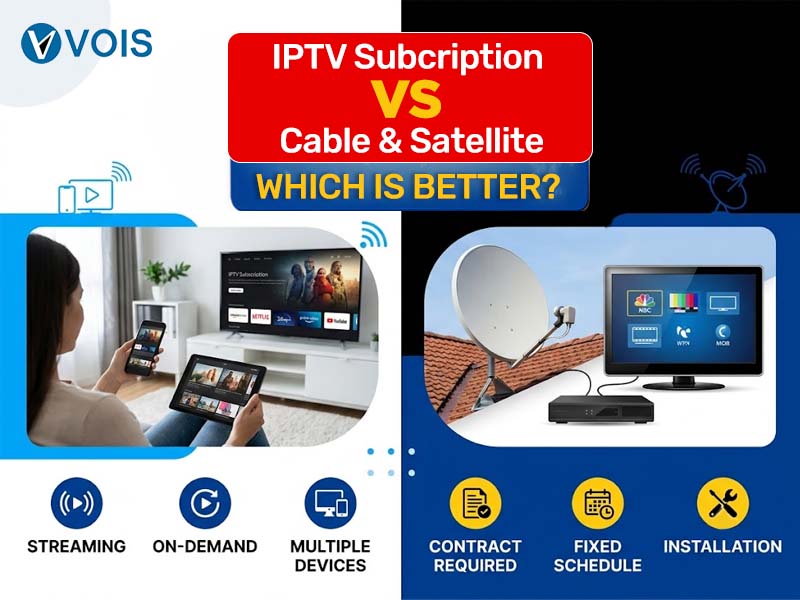
Just ask any person younger than 40 how he watches television now and you will probably not hear anything about cable. An IPTV Subscription has actually become one of those things which can compete with cable and the dish antenna. The real issue here is whether there is any advantage in it or if it is simply hype.
Get access to thousands of live channels, movies, sports, and entertainment in HD and 4K. Choose a Vois IPTV subscription plan and start enjoying premium entertainment today.
VIEW IPTV SUBSCRIPTION PLANSInternet Protocol Television (IPTV) transmits channels and content via the internet as compared to the signals received through the satellite or coaxial cable into the house. You don’t have to deal with a programming grid for scheduling your night’s entertainment. Live television, movies, or any program is delivered to any screen that you may be sitting at, from smart TVs, smartphones to tiny streaming devices. These are basically the reasons cord-cutters choose IPTV; it gives them freedom while still having their channels.
Most people already know this part. Cable gets to your house through physical lines a local company installs. Satellite skips the cables and beams a signal down to a dish bolted to your roof. Either way, you’re usually signing a contract, paying rental fees on a box and waiting around for an install appointment before anything even turns on.
Cable and satellite mean scheduling a technician, sometimes drilling into your house for a dish and dealing with a pile of cords. An IPTV Provider usually just needs your Wi-Fi and an app — you could be watching something within minutes of signing up.
Long contracts, rental fees, random line items you didn’t expect — that’s the cable and satellite playbook. IPTV plans skip most of that. They’re typically month-to-month and cost noticeably less than a bundled package from a traditional provider.
Ever pay for 200 channels and only watch five of them? That’s the cable model. IPTV tends to work the other way — pick the news, or entertainment content you actually care about instead of paying for filler.
One nice thing about IPTV: it isn’t tied to a single TV. Someone’s watching in the living room, someone else has a show going on a tablet in the kitchen — it all works at once. Cable and satellite generally lock you to one receiver per television, which gets old fast in a busy household.
| Feature | IPTV Subscription | Cable TV | Satellite TV |
| Installation | Minimal, app-based setup | Technician visit required | Dish installation required |
| Contract Length | Flexible, often monthly | Usually 12–24 months | Usually 12–24 months |
| Device Compatibility | Multi-device streaming | Limited to cable box | Limited to satellite receiver |
| Cost | Generally lower | Moderate to high | Moderate to high |
| Weather Dependency | Depends on internet stability | Rarely affected | Can be affected by weather |
| Content Customization | Highly customizable packages | Fixed bundles | Fixed bundles |
A few reasons keep coming up when people explain why they left cable behind for an IPTV Service Provider:
Not all service providers will be dependable, so a little bit of research really helps. Try to find an IPTV Provider with good uptime, customer support that responds and a channel lineup relevant to your area. Most providers with good reputations offer an IPTV Free Trial, which is the easiest way to test image quality and app performance without even giving your card details.
If your Wi-Fi is fast and doesn’t drop out, switching to an IPTV Subscription tends to make sense — fewer contracts, smaller bills, more devices covered. But if your internet connection is unreliable, cable or satellite might still win out, since neither one cares how your bandwidth is doing.
Not sure which IPTV service is right for you? Start with a free trial and experience the channels, streaming quality, and entertainment available with Vois IPTV before making your decision.
START YOUR FREE TRIALThere isn’t one universal winner here. Cable and satellite still make sense for people who’d rather not think about switching and just want something that works. IPTV keeps pulling in new subscribers because it’s cheaper, runs on more devices and lets you build a lineup around your own habits instead of a provider’s bundle. Look at your internet, your budget and how you actually watch TV and the answer tends to show itself.
IPTV technology itself is legal. However, the legality of the content depends on the service provider and whether the provider has the necessary rights or licenses to distribute the channels and content.
Not necessarily. IPTV services can work on compatible smart TVs, streaming devices, set-top boxes, tablets, computers, and mobile phones. A stable internet connection and a compatible device are generally the main requirements.
Around 10 to 25 Mbps may be sufficient for many HD IPTV streams, while 4K streaming generally requires a faster and more stable connection. Slower or unstable internet can result in buffering and reduced streaming quality.
Many IPTV providers offer a free or paid trial, allowing you to check the available channels, streaming quality, application compatibility, and overall experience before choosing a subscription.
IPTV can be more affordable than traditional cable or satellite TV depending on the provider, package, equipment, and features included. Comparing the total monthly cost and contract terms can help you determine which option offers better value for your needs.