
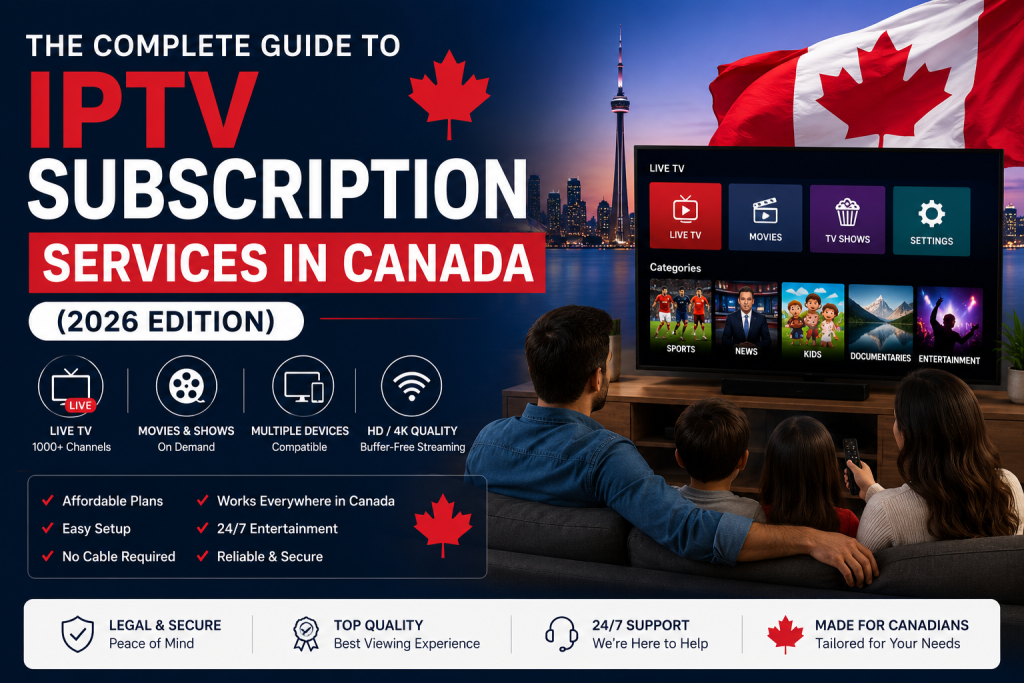
Cutting the cord doesn’t mean cutting yourself off from the shows, sports, and channels you love. In fact, for thousands of households across the country, switching to an IPTV subscription has turned out to be one of the smartest entertainment decisions they’ve made in years. Whether you’re an Indian family missing your favorite Bollywood dramas, a sports fan chasing every live match, or simply someone tired of paying cable prices for channels you never watch, IPTV has quietly become the go-to solution for modern home entertainment in Canada.
In this guide, we’ll walk through everything you need to know about IPTV Canada services — how they work, what to look for in a provider, what an IPTV free trial actually gets you, and why a platform like Vois IPTV has become a popular choice for Canadian households looking for reliable, affordable streaming.
IPTV stands for Internet Protocol Television. Instead of receiving channels through a satellite dish or a cable line buried under your street, IPTV delivers live television and on-demand content over your internet connection. Think of it as streaming — similar in concept to Netflix or YouTube — except instead of a curated library of shows, you get access to thousands of live channels from around the world, all delivered in real time.
For Canadian households, this shift matters for a few very practical reasons:
Canada is one of the most culturally diverse countries in the world, and that diversity shows up clearly in what people want to watch. A large and growing South Asian population, for example, wants access to Hindi, Punjabi, Tamil, Telugu, Bengali, Gujarati, Malayalam, and Urdu programming — content that traditional Canadian cable providers have historically treated as a niche afterthought.
This is exactly the gap that dedicated IPTV Canada providers have stepped in to fill. Rather than offering two or three token international channels tucked inside a pricey add-on package, IPTV services are built from the ground up to prioritize this kind of content, alongside mainstream Canadian, American, and global programming.
A few forces have accelerated this shift:
One provider that illustrates this trend well is Vois IPTV (voisiptv.ca), a Canada-based IPTV service built with a strong focus on Indian and South Asian audiences, while still offering broad, mainstream international coverage.
Vois IPTV’s core offering centers on a few standout numbers: over 15,000 live channels in HD and 4K, and a library of more than 500,000 movies and shows available on demand. That combination — live TV plus a substantial video-on-demand library — is what separates a serious IPTV provider from smaller, less reliable operations.
Vois IPTV’s channel lineup is genuinely extensive, covering:
This kind of breadth means a single household subscription can realistically serve grandparents who want their regional news channel, parents who want live cricket, and kids who want English-language cartoons or shows — all without needing separate accounts or add-on packages.
Vois IPTV supports a range of hardware, including MAG540-W3, MAG544-W3, MAG555, and Unipro 4.0 IPTV boxes, alongside app-based access for those who’d rather stream directly through a smart TV or mobile device without dedicated hardware. This flexibility matters because not every household wants a physical box sitting under the TV — some prefer the simplicity of an app they can install on a device they already own.
Beyond channel count, the features that actually shape day-to-day viewing experience include:
These are the kinds of features that used to be reserved for premium cable packages, now bundled as standard parts of a single IPTV subscription.
One of the most common questions people have before switching to IPTV is simple: how much does it actually cost, and what am I getting for that price? Subscription structures vary between providers, but they generally follow a similar pattern — a base package with a set number of channels and VOD content, then optional add-ons for hardware, extended contract length, or premium sports packages.
Here’s a representative breakdown of how Vois IPTV structures its plans, which is a useful reference point for understanding pricing patterns across the IPTV Canada market generally:
| Plan Type | Hardware Included | Subscription Length | Price (CAD) | Channels | VOD Library | Streaming Quality |
|---|---|---|---|---|---|---|
| Mag544W3 Bundle | Mag544W3 Box | Lifetime | $400 | 15,000+ | 500,000+ | 4K |
| Mag540W3 Bundle | Mag540W3 Box | 5 Years | $399 | 15,000+ | 500,000+ | 4K |
| Mag555 Bundle | Mag555 Box | 5 Years | $470 | 15,000+ | 500,000+ | 4K |
| Unipro Bundle | Unipro 4.0 Box | 5 Years | $400 | 15,000+ | 500,000+ | 4K |
| App-Only (Long Term) | None (App Only) | 5 Years | $420 | 15,000+ | 500,000+ | 4K |
| App-Only (Short Term) | None (App Only) | 3 Years | $250 | 15,000+ | 500,000+ | 4K |
A few things stand out when you look at this table. First, the channel count and VOD library stay consistent across every plan — the real variable is whether you want dedicated hardware or prefer to use an app on a device you already own, and how long a subscription term you’re comfortable committing to upfront. Second, longer-term plans generally offer better value per year than shorter ones, which is a common pattern across the IPTV subscription market, not just with this one provider.
When comparing IPTV subscription options across different providers, it’s worth checking:
It’s easy to skip past the phrase “free trial” as marketing noise, but with IPTV specifically, a trial period serves a genuinely practical purpose that goes beyond simply trying before you buy.
Streaming quality depends heavily on factors that are specific to your household: your internet speed, your router’s capability, the device you’re streaming on, and even the time of day you typically watch. An IPTV free trial lets you test all of these variables in your actual home environment before committing to a longer subscription term.
Here’s what a good free trial should let you evaluate:
Vois IPTV, for example, offers a dedicated free trial specifically so new users can test channel availability, streaming performance, and device compatibility before paying anything. This kind of no-commitment testing period is exactly what separates trustworthy providers from services that pressure you into a long-term contract before you’ve verified anything works.
If a provider is unwilling to offer any kind of trial or short-term test option, that’s worth treating as a caution flag. A confident, well-run service should have no problem letting you test the waters first.
With so many IPTV providers now competing for attention in the Canadian market, it helps to have a clear framework for comparing them. Here are the factors that matter most:
This is the single most important factor, and unfortunately the one most often ignored. A legitimate IPTV provider should be operating with properly licensed content, not redistributing pirated streams. Ask directly whether the service is legal, and be skeptical of providers who dodge the question or seem evasive about their content sourcing.
More channels isn’t automatically better if none of them are ones you’d actually watch. Look specifically for the regional, cultural, and sports channels that matter to your household, rather than being impressed by a large total number alone.
4K and HD streaming claims are only meaningful if the provider’s server infrastructure can actually support them without buffering, especially during high-traffic hours like weekend sports matches or prime-time TV slots.
Check whether the service supports the specific devices in your home — Android boxes, Linux-based boxes like MAG devices, smart TVs, or mobile apps — rather than assuming universal compatibility.
24/7 support sounds great on paper, but the real test is responsiveness. Does the provider offer phone support, WhatsApp, or live chat? Are real humans answering, or are you stuck in an automated loop?
Watch for hidden monthly fees that get added after the initial subscription period, unclear refund policies, or vague language around what happens after a trial ends.
As covered above, a genuine trial period is one of the clearest signals of a provider’s confidence in their own service quality.
For households on the fence about switching, it helps to compare IPTV against traditional cable directly across the factors that matter most day-to-day.
| Factor | Traditional Cable | IPTV Subscription |
|---|---|---|
| Installation | Technician visit required | Self-setup, usually within minutes |
| International/Regional Channels | Limited, often in costly add-on tiers | Extensive, often included as standard |
| Contract Flexibility | Often long-term contracts with penalties | Flexible terms, from months to years |
| Device Compatibility | Requires cable box per TV | Works across TVs, phones, tablets, boxes |
| On-Demand Library | Limited | Often includes hundreds of thousands of titles |
| Pricing Transparency | Frequent hidden fees and rate increases | Generally more transparent, fixed-term pricing |
| Trial Period | Rare | Commonly offered |
This comparison isn’t meant to suggest cable has no advantages — reliability and simplicity for less tech-savvy users are real considerations — but for households that want more content variety, especially regional and international programming, IPTV consistently comes out ahead on flexibility and value.
One of the more reassuring aspects of switching to IPTV is how straightforward the setup process usually is compared to what people expect. Here’s a general outline of what the process looks like with most reputable Canada IPTV providers:
For most households, the entire process — from signup to first stream — takes well under half an hour, a stark contrast to scheduling a cable installation appointment and waiting days for a technician.
While IPTV appeals to a broad range of households, a few groups in particular tend to see the clearest benefit:
Is IPTV legal in Canada? Legality depends entirely on the specific provider and how their content is sourced. Reputable providers operate with licensed content and are transparent about their legal standing. Always confirm this directly with any provider before subscribing.
Do I need special hardware? Not necessarily. While dedicated boxes like MAG or Android devices can offer a more traditional TV-box experience, many providers also offer app-based access that works on smart TVs, phones, and tablets you already own.
How much internet speed do I need? For smooth HD streaming, a stable connection of at least 10-15 Mbps is generally recommended, with closer to 25 Mbps or more ideal for consistent 4K streaming, especially if multiple devices in your household are streaming simultaneously.
Can I use IPTV on multiple devices at once? This depends on the specific plan and provider — some subscriptions support multi-screen viewing as a built-in feature, allowing different family members to watch different channels simultaneously on different devices.
What happens after my free trial ends? This varies by provider, but typically you’ll be prompted to choose a paid subscription plan to continue service. A trustworthy provider will make this transition clear and won’t auto-charge you without explicit consent.
The IPTV Canada market has matured significantly over the past few years, moving well past its early reputation as a niche, somewhat unreliable alternative to cable. Today, established providers offer genuinely competitive channel libraries, dependable streaming infrastructure, and subscription structures that make sense for a wide range of household budgets and viewing habits.
If you’re considering making the switch, the smartest first step is almost always the same: start with an IPTV free trial before committing to a longer-term plan. Test your specific channels, confirm your devices work smoothly, and get a feel for the interface with your actual household usage patterns — evenings, weekends, multiple simultaneous streams — rather than relying on marketing claims alone.
Once you’ve confirmed the streaming quality and channel lineup meet your expectations, choosing the right IPTV subscription length and hardware setup becomes a straightforward decision based on your budget and how long you’re comfortable committing. For many Canadian households, especially those craving reliable access to regional and international content, that decision has already paid off in the form of better entertainment value and far fewer frustrations than traditional cable ever offered.